
Backbone or Bottleneck
How organizational networks stratify — and what managers can do to fix it.

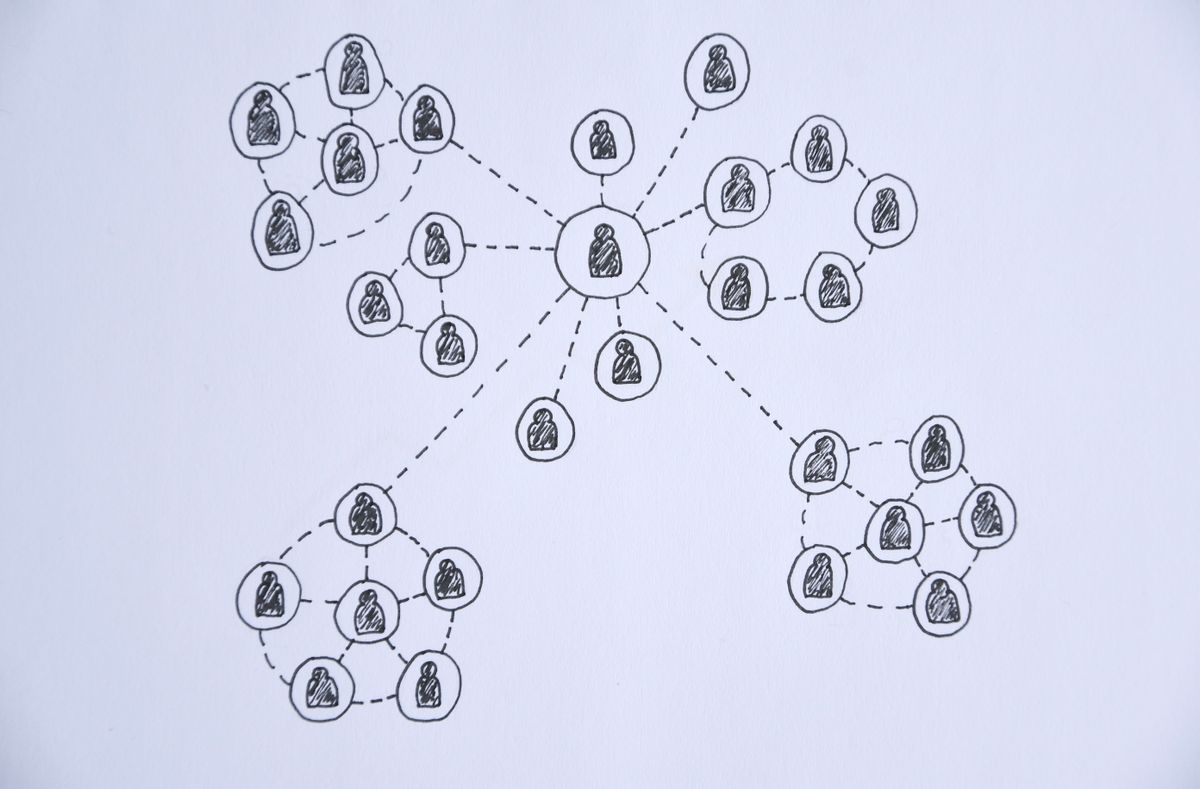
We’ve made the case that managers are the backbone of an organization, the connective tissue between those who plan and those who execute. That’s the promise of the role. Reality is messier because the relationship infrastructure a manager sits inside isn’t flat, and left alone, it becomes increasingly narrow.
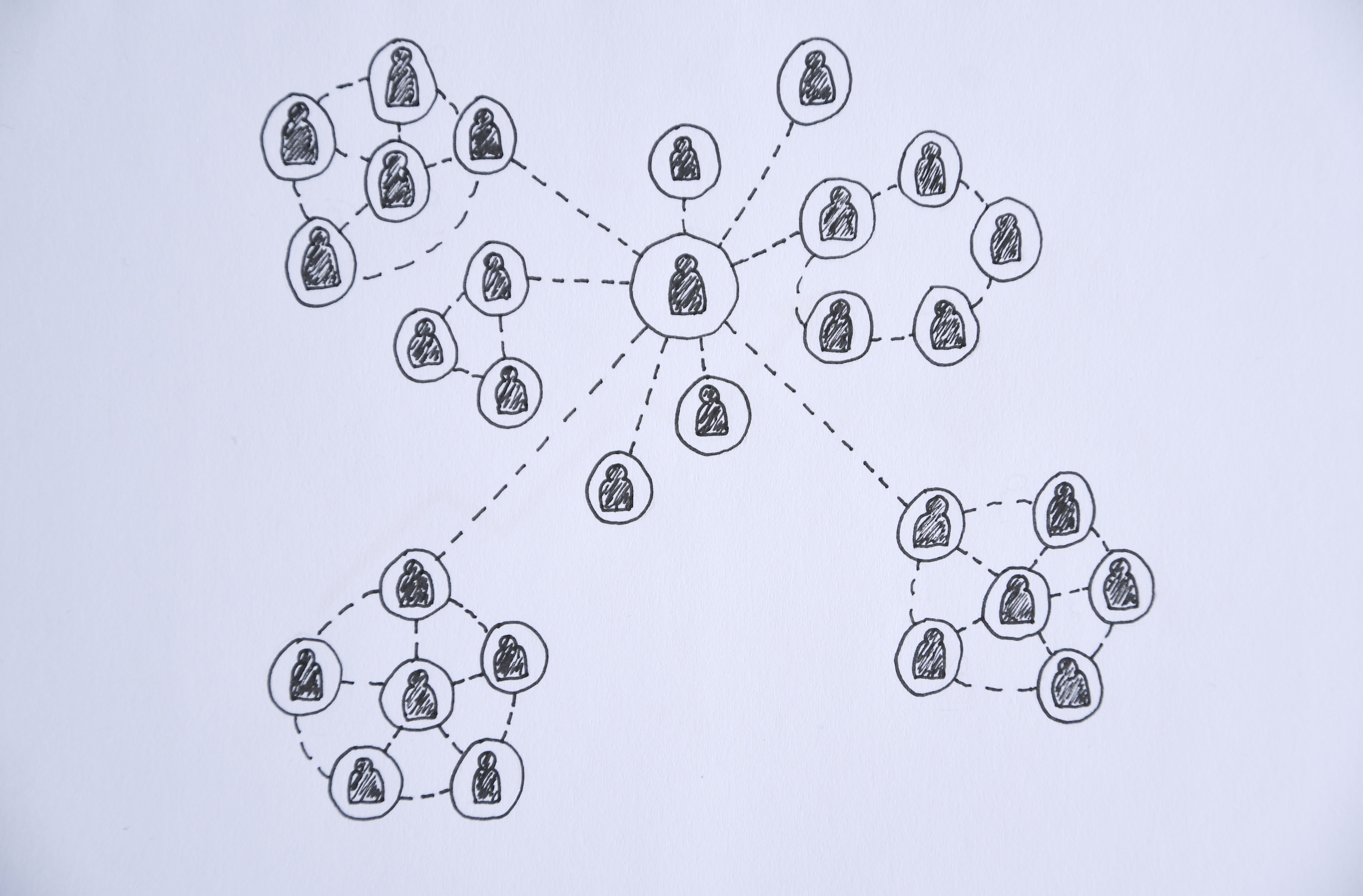
An org chart shows boxes and reporting lines. The actual organization runs on who talks to whom, who trusts whom, and who gets the early word. That informal network tends towards stratification through forces nobody designed and most leaders never see.
Ronald Burt spent decades documenting the first force. People whose relationships span otherwise-disconnected groups—brokers, in his language—get promoted faster, paid more, and rated higher. They see through the walls that everyone else is stuck behind. We’d expect organizations to reward that, and they do. The catch comes from a finding Burt published in 1998, and researchers have since extended it. The same broker position that lifts an insider can stall an outsider. In his study of senior managers at a large electronics firm, women who built wide, bridging networks were delayed in promotion unless a senior figure vouched for them. The network behavior was identical. The treatment of it was not.
Two quieter forces compound the problem. We connect with people like us, creating the most reliable pattern in network research, documented by McPherson, Smith-Lovin, and Cook across every kind of relationship they measured. And the well-connected accumulate connections faster than everyone else, a rich-get-richer dynamic that turns a small early advantage into a permanent one. Add the shift to remote and hybrid work, and the walls grow taller. A 2022 study of more than 60,000 Microsoft employees found that company-wide remote work cut collaboration across groups and thinned the bridging ties between them, though that’s one company at one moment early in the pandemic, so we hold the finding loosely.
The result is an organization where a handful of people carry most of the load. Rob Cross’s consulting work reports that 20% to 35% of value-added collaboration comes from 3% to 5% of employees. Whatever the precise figure, the shape is familiar to anyone who’s run a team. A few people sit in every meeting and every thread, and they’re exhausted. Everyone else drifts to the edges, and the people on the edges are disproportionately women, newer hires, and those working from home.
Where good intentions go to die.
The peer-reviewed evidence on costs is stronger than the consulting figures. A 2018 meta-analysis covering more than 4,000 workgroups and 21,000 people found that when a manager builds much closer relationships with some reports than others, the team’s cohesion and sense of fairness suffer, even when the favored members thrive. Stratifying relationships within a team comes at a cost borne by the whole team. That research is mostly survey-based, so we are careful not to claim strict cause and effect, but the pattern holds across study after study.
What do we do with a network that bends toward inequality on its own?
The early moves are diagnostic and structural. We can map the real network rather than guess at it, using the collaboration data most companies already have. We can find the overloaded brokers and move work off them before they break. We can build cross-group ties into the work itself through rotations and project assignments. A 2024 study found that simply moving people between units erased the gender gap in the returns to brokering, because mobility grants outsiders the legitimacy they would otherwise be denied.
The most significant action is the one closest to the backbone itself: what a manager does, week after week, with the network they’re standing in.
A manager has two ways to hold that position. They can pull work and information inward, becoming the hub everything routes through, which feels like control and looks like indispensability and quietly makes them the bottleneck the whole team waits on. Or they can push their people outward, brokering connections between their team members and the wider organization, expanding the network rather than hoarding it. The first manager is a choke point. The second is a backbone, a structure that connects, carries a load, and holds the body upright without trying to be the body.
The most useful thing we’ve learned about doing the second job well comes back to Burt’s legitimacy finding, and it runs hard against instinct. For someone on the margin of the organization—the new hire, the remote contributor, the person who doesn’t look like the people in charge—the manager’s own endorsement does surprisingly little. A boss advocating for their own report is exactly what everyone expects a boss to do, so the praise carries the discount that comes with obligation. What actually shifts the outcome is a vouch from someone under no duty to give it: a senior figure elsewhere in the organization, lateral or above, with standing and nothing to gain. Burt found that outsiders advanced when a more distant sponsor corroborated their manager, not when the manager simply pushed harder on their behalf.
That reframes the manager’s real job around brokering rather than advocacy. The leverage comes from connecting their people to the figures whose word counts precisely because it isn’t owed. In practice, it looks small and unglamorous: a name passed to a peer in another function, an introduction made before a project kicks off, a quiet word that puts a junior contributor in the room where a senior leader can watch the work firsthand and form an opinion of their own.
A warning belongs here, because the appealing fixes are often the weak ones. Belonging campaigns and “you matter here” messaging feel like progress, and a rigorous field experiment with 500 new engineers found that a belonging intervention borrowed from education moved none of the advancement gaps it was built to close—not bonuses, not promotions, not network position. Informal mentoring sounds healthier than it is, since most people find their mentors through their existing networks, which means the practice quietly reproduces the same stratification it’s sold to fix. And the celebrated super-connector is often a single point of failure we’ve chosen to admire instead of address.
The state of the evidence is that we understand why networks stratify far better than we know how to reliably un-stratify them. The research on intervention is thin and relies on case studies. Thin evidence is no reason to wait. The smarter response treats network-building as deliberate work, designed into the structure of the work and a manager’s weekly habits, rather than something we hope happens on its own.
A backbone connects what would otherwise fall apart. The managers who grasp that their real product is connection, not control, are the ones who turn a stratified org chart into an organization that can actually move.
This work synthesizes peer-reviewed research on organizational networks and leadership — including Ronald Burt’s work on brokerage and social capital, McPherson, Smith-Lovin & Cook on homophily, Yu, Matta & Cornfield’s meta-analysis on leader-member exchange differentiation, Yang et al.’s study of remote work at Microsoft, and Zhang, Aven & Kleinbaum on mobility and brokerage alongside practitioner research from Rob Cross on collaborative overload.
Contact us for a complete list of works cited.